Šta li je sledeće...
https://newconsumer.com/2020/09/on-cyclon-running-shoe-subscription/
Would you subscribe to these shoes?
The “end of ownership” is coming for your running gear.
By Dan Frommer on September 21, 2020
<https://www.on-running.com/> On, the fast-growing running gear company based in Switzerland, has a new, lightweight shoe coming out next year, called the <https://www.on-running.com/en-us/articles/subscribing-to-the-future> Cyclon.
Unlike its previous shoes, the company says Cyclon is 100% recyclable, made largely with a bio-polymer derived from castor beans. Also unlike its previous shoes, you won’t be able to buy Cyclon — you can only subscribe to them as a $30 monthly service.
The idea is that every six months or so, when it’s time to get a new pair — runners are expected to replace their shoes every few hundred miles for performance, safety, and comfort — you’ll request a new set and mail your used ones back to On. They’ll then recycle them. And because it’s a service, you’ll just keep paying the same subscription fee.
Will this work? Is this simply how people will get shoes and gear in the future? And might this become an important model for more of the apparel business?
The New Consumer Executive Briefing is exclusive to members — <https://newconsumer.memberful.com/checkout?plan=37145&utm_source=website&ut…> join now to unlock this 1,100-word post and the entire archive. Subscribers should <https://newconsumer.com/?memberful_endpoint=auth> sign in here to continue reading.
Hi, I’m Dan Frommer and this is The New Consumer, a publication about how and why people spend their time and money.
I’m a <https://newconsumer.com/about> longtime tech and business journalist, and I’m excited to focus my attention on how technology continues to profoundly change how things are created, experienced, bought, and sold. The New Consumer is supported entirely by your <https://newconsumer.com/subscribe> membership — join now to receive my reporting, analysis, and commentary directly in your inbox, via my twice-weekly, member-exclusive newsletter. Thanks in advance.
<https://newconsumer.memberful.com/checkout?plan=46192&utm_source=website&ut…> Join: $20 / Month <https://newconsumer.memberful.com/checkout?plan=37145&utm_source=website&ut…> Join: $200 / Year <https://newconsumer.com/subscribe/> More Options
Sent from my iPad 2018
https://edition.cnn.com/2020/09/24/tech/amazon-ring-drone/index.html
Amazon's Ring will sell a $250 security drone that flies around your home
<https://edition.i.cdn.cnn.com/.a/2.239.2/assets/video_pinned_white_bg.jpg>
(CNN Business) — Ring, the Amazon-owned home security business, introduced a flying camera on Thursday that may excite home-surveillance fans but is almost certain to rankle privacy advocates.
The $250 drone, called Ring Always Home Cam, is among a slew of products unveiled during Amazon's <https://www.cnn.com/2020/09/24/tech/amazon-echo-alexa-event-2020/index.html> invitation-only online hardware event.
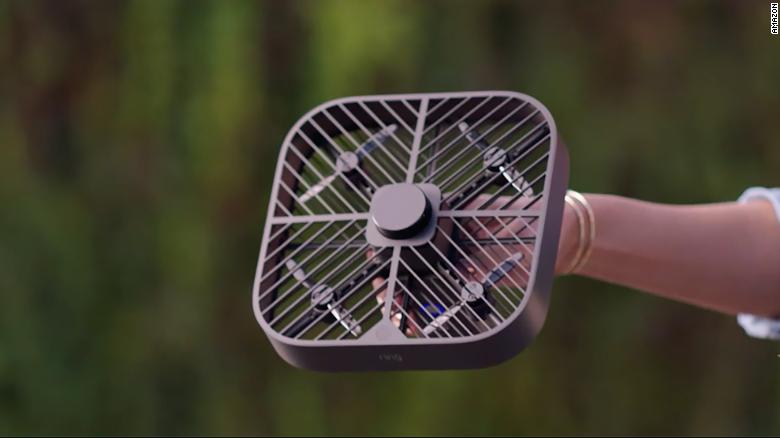
The drone is small and light, with a high-definition camera, and it can automatically fly on preset paths to specific spots in your home, streaming video to your smartphone of what it sees along the way. Users can set up paths for the drone via a smartphone app, or if the drone detects motion in a part of your home it can fly on its own to that spot and take video of what's going on. Set for release next year, the drone is meant for indoor use only, and it can be set to work with the Ring Alarm system so that it will fly a preset route if the alarm is triggered.
<https://cdn.cnn.com/cnnnext/dam/assets/200924145948-ring-always-home-cam-ex…> <img alt="" class="media__image" src="//cdn.cnn.com/cnnnext/dam/assets/200924145948-ring-always-home-cam-large-169.jpg">
The drone's camera appears to be mounted on a short trunk extending below its propellers (which are housed in a square cage), and will only record when the drone is flying, said Leila Rouhi, president of Ring, as she introduced the device. The camera is blocked when the drone is sitting in its dock, she said.
"We know when something happens our customers want to be able to see exactly what's going on, but it's not always feasible to have whole-home coverage," Rouhi said, explaining why Ring created the drone.
Though the Always Home Cam is said to be coming next year, Ring did not show the drone actually flying. Video that appeared to be taken from a drone's perspective inside of a home was captioned with a note that read "Functionality simulated for illustrative purposes only", and video footage showed Rouhi holding it.
<https://cdn.cnn.com/cnnnext/dam/assets/200924150957-02-ring-always-home-cam…> <img alt="" class="media__image" src="//cdn.cnn.com/cnnnext/dam/assets/200924150957-02-ring-always-home-cam-amazon-event---screenshot-large-169.jpg">
The device's ability to navigate your home is sure to concern privacy experts, who have already blasted Amazon for Ring's partnerships with hundreds of police departments around the US; though these deals are meant to make it easier for local law enforcement to access videos taken by users, privacy advocates <https://www.cnn.com/2019/08/29/us/ring-cameras-police/index.html> see it as a way to build a widespread surveillance network.
In an effort to assuage some privacy fears in advance, Ring said the drone is meant to be noisy while in flight — making it obvious when it's in use -— and that it can't be manually controlled.
Sent from my iPad 2018
https://www.techspot.com/news/86722-softbank-reportedly-closing-40-billion-…
SoftBank reportedly closing a $40 billion sale of ARM to Nvidia, announcement imminent
The complexion of the semiconductor landscape is about to change
Eric Hamilton,Today 1:11 AM
Why it matters: After weeks of speculation about the future of ARM, it seems a deal is about to be struck between SoftBank and Nvidia, allowing the GPU maker to acquire ARM in what would be one of the most expensive tech acquisitions in history. Any such deal involving tech giants is guaranteed to be met with regulatory force, but Nvidia is likely betting it can assuage lawmakers and regulators.
According to a report from The Wall Street Journal, SoftBank and Nvidia are nearing a deal for the graphics giant to acquire ARM for $40 billion in a cash and stock transaction. SoftBank acquired Arm for around $31 billion in 2016, and in recent months has been looking to offload the chip design and IP company in an effort to mitigate losses. Nvidia has increasingly emerged as the most interested party.
While the terms of the deal have yet to be revealed, an official announcement could come as early as next week. The deal will undoubtedly come under scrutiny and be subject to regulatory approval. Arm's co-founder has previously said that an Nvidia acquisition would be a disaster, and that Arm should be brought back home to the UK.
One key concern stemming from an Nvidia acquisition is retaining ARM's neutrality in licensing its chip designs and IP. SoftBank isn't a chip maker, and as such, isn't competing with other manufacturers like Samsung, Apple, Intel, Broadcom, and Qualcomm, just to name a few -- all of whom are ARM licensees.
Nvidia controlling access to such an important and broad ecosystem that the industry relies on could be seen as a conflict of interest and is bound to raise concerns.
Largest tech deals in history
Company Acquisition Price Year
Dell EMC $64 billion 2015
Avago Broadcom $37 billion 2015
IBM Red Hat $34 billion 2018
Softbank ARM Holdings $31.4 billion 2016
Microsoft LinkedIn $26.2 billion 2016
Nvidia has shown that it wants to continue its vertical integration and forge ahead in high performance compute, AI, data center infrastructure, and supercomputers. They've made several acquisitions in an effort to scale its ambitions across not only its GPUs, but also its software stack and networking. Nvidia recently acquired Mellanox Technologies and Cumulus Networks, and brought them under the Nvidia Networking brand. The end goal is the desire to more tightly couple Nvidia's HPC platforms with networking hardware and software.
Nvidia wants to do the same with GPUs and CPUs -- except it lacks any CPUs of its own. Bringing in ARM under its umbrella may allow them to compete for lucrative exascale supercomputer contracts that Intel and AMD are enjoying. Recently, ARM-based supercomputers have made more of a splash, with Japan's Fugaku supercomputer dethroning IBM's Summit as the world's most powerful supercomputer.
Nvidia has its line of Tegra SoCs, and others, that have historically leveraged ARM's instruction set and Cortex-Axx series of CPUs, but that's not the same has having custom CPU and GPU design under the same roof.
Having its own CPU design in-house would allow Nvidia to better conjoin ARM CPUs to its GPU accelerators, and put it on a more level playing field with Intel and AMD. Nvidia already announced it'll bring Cuda to ARM and enable Nvidia's full stack of HPC software within the ARM ecosystem. Custom ARM CPUs could be the next step, as far as Nvidia is concerned.
We likely won't have to wait long to see how this development plays out, and if it does, it will be one of the biggest tech acquisitions in history and have a serious ripple effect on the semiconductor industry.
Image credit: Daniel Constante
Sent from my iPad 2018
Nije mi baš jasno šta će mi providni televizor :) ali impresivno deluje
-----Original Message-----
From: Klub <klub-bounces(a)lists.matematicka.com> On Behalf Of Dragan Citakovic
Izgleda kao iz SF filmova... ono Minorty Report i slično.. :)
Evo i kratkog videa u poruci.
https://www.dezeen.com/2020/08/15/xiaomi-transparent-tv-mi-tv-lux/
https://news.samsung.com/uk/samsung-launches-4k-ultra-short-throw-laser-pro…
Samsung Launches 4K Ultra Short Throw Laser Projector: The Premiere
LSP9T and LSP7T will provide a true home cinema experience
London, UK – 2nd September – Samsung Electronics Co., Ltd. announced its all new 4K Ultra Short Throw laser projector, The Premiere, at its virtual press conference event “Life Unstoppable” on September 2nd. The new 4K laser projector provides a big picture cinematic experience in the comfort of one’s home. The Premiere is the new anchor product in the award-wining Lifestyle product portfolio that now transcends the display experience – without the display.
Samsung will begin to rollout The Premiere globally starting from the US, Europe, Korea, and other regions later this year.
The Premiere will be available up to 130- and 120-inch models – LSP9T and LSP7T respectively – that support a laser powered 4K picture resolution. The Premiere LSP9T is the world’s first HDR10+ certified projector with triple laser technology and delivers revolutionary contrast details as the user watches from bright to dark scenes with a peak brightness of up to 2,800 ANSI lumens. The Premiere also supports Filmmaker Mode for the first of its kind as a projector allowing users to enjoy watching movies as the directors intended. The smart projector comes equipped with Samsung’s Smart TV platform and experience full of streaming video apps from major content partners and mobile connectivity features such as Tap View and mobile mirroring.
The Premiere features an all-in-one compact, space-saving design that blends into a variety of living room settings and arrangements. As it is an ultra-short-throw projector, The Premiere can be placed just in front of the wall*. It is designed for an easy-to-install set up and sports fabric finishes around its edges to harmonise different environments. The Premiere has powerful built-in woofers and Acoustic Beam surround sound**, providing one of the best home cinema experiences on the market today, and reduces the need for additional bigger sound equipment in tighter spaces.
“Over the past few months, we have seen how consumers are spending more time at home and how the role of everyday life continues to change. TV has become the centre of entertainment, a fitness partner, a co-worker and a source for news,” said Jongsuk Chu, Executive Vice President of Visual Display Business at Samsung Electronics. “The Premiere re-imagines the home cinema experience with an all-new, compact design, 4K picture quality and big sound for tight spaces that can be used for any at-home activity and living room arrangements.”
Samsung first launched its Lifestyle product portfolio with The Serif in 2016 and has since expanded it to the award-winning TV line-up of The Frame, The Sero and The Terrace. By enhancing elements that speak to the consumer passion points for art, interior designs and the mobile experience, Samsung’s Lifestyle product line-up functions have evolved to become a central hub for a wide array of lifestyles.
Notes:
* LSP9T can be placed as close as 11cm to the wall
** Acoustic Beam Surround Sound only available on LSP9T
Sent from my iPad 2018